Posts

Doublet Maintenance at the Ranch
Image
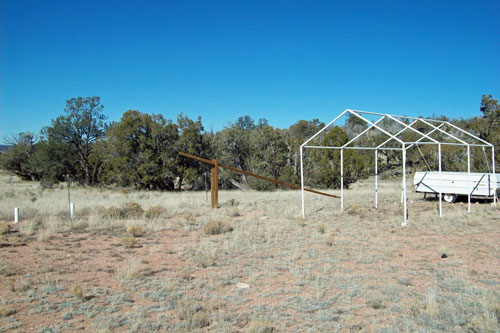
  Doublet Maintenance at the Ranch Filed in Antennas on Feb.07, 2011 John, his son Dan and I met up at the Ranch in late December as they were passing through on the way to California.  When we arrived on Friday afternoon, it was apparent that the 135′ doublet antenna had broken away from the mast on the west end.  We had used some Blue and White rope from the insulator at the end of the antenna to the mast.  That rope lasted about 1-1/2 years in the elements of Northern Arizona.  We decided to fix it on Saturday. First, we lowered the mast on the east end by pulling the pin at the bottom, and tilting it over.  While it was down, we used some clothes line that I had left over from another project to reconnect the antenna to the mast.  We also cut the guy ropes in the middle, where they had been sliding back & forth through an eyelet at the top of the mast.  To prevent fraying, we tied each guy rope separately to the mast eyelet....

First Mobile VHF Rig

Image
  First Mobile VHF Rig Filed in Station on Dec.10, 2010 In July of 1981, Mom gave me a nice birthday gift. A Kenwood TR-7800 2-meter mobile rig.  It had 25 watts out, and a synthesizer to eliminate the need for crystals.  There was no tone board installed, but you really didn’t need one in the midwest back then, as few of the repeaters had tone access. It was nice to have the touchtone pad on the front.  It allowed for direct frequency entry and for using the telephone autopatch that was installed on some of the repeaters.  That’s what we used before everyone had cellphones.  I remember dialing up a number, and having to tell the people on the other end right away that we were on the radio, so they would not say something inappropriate over the air. I still have the rig.  It is mounted in my Nissan Frontier behind the seat, and is used as an APRS transmitter when I remember to turn it on.   TR-7800 when new   Migrated Comments...

Ham Shack 1985

Image
  Ham Shack 1985 Filed in Station on Dec.08, 2010 In 1985, we lived in Garden City, Kansas. I was scanning in some old negatives today, and came across these.  Nice looking shack back then…   Hamshack 1985 I was a member of Navy/Marine Corps MARS back then (NNN0AFM). The equipment was: Top Shelf: TH-21 2 Meter HT, Antenna Switch, Navy OS-8C Monitor Scope (For RTTY Tuning) Middle Shelf: MFJ-949 Antenna Tuner, Homebrew Audio Switchbox, IRL-FSK500 RTTY MODEM Bottom Shelf: Astron RS-20A Power Supply, Yaesu SP-107 Speaker, Kenwood TS-430 Behind me is a TRS-80 Model 4, with single 5-1/4″ floppy (360K) and built in Green Screen 80×50 character monitor.  This was a big upgrade from the TRS-80 Color Computer that used a cassette recorder to store data. Shack w/o me blocking view

43′ Vertical Matching Network Debugging – con’t

Image
  43′ Vertical Matching Network Debugging – con’t Filed in Antennas on Nov.02, 2010 I got the matching network back on the bench tonight.  I started by confirming that the Unun leads are as I expected. I hooked a 220 ohm resistor across what I thought was the high impedance side, and connected the Rx Noise Bridge across the low impedance side.  I read very close to 50 ohms with zero reactance on the low impedance side.  So the Unun is working correctly. Next, I wired the Unun back into the matching network.  Again, hooking the 220 ohm resistor across the output, I measured the input: Nearly ZERO ohms!  (This was with the relays de-energized, so the coils were out of the circuit. So I suspected either the caps between the input and the Unun, or the choke for the relay power.  I disconnected both, and temporarily hooked up only the caps on the input to the Unun.  Aha! back to very close to 50 ohms through the caps to the low side of th...

43′ Vertical Matching Network Debugging

Image
  43′ Vertical Matching Network Debugging Filed in Antennas on Aug.20, 2010 We had some trouble getting the 43′ vertical matching network working at Field Day.  With primitive tools and workspace, we did what debugging we could at the time, and determined that it was miswired.  I must have left it that way and forget where I was in the project at some point.  Anyway, Don, W9BHI found our blog and mentioned that the pictures showed that it was incorrectly wired. I haven’t dug the matching network back out yet, but here are two pictures of the last state we were in before we finally removed and used the Unun standalone with the vertical for 40 – 6 meters for the rest of Field Day.     Re-wired matching network – Right side   Rewired matching network – Left Side I believe it was wired correctly at this point, but there was obviously something still wrong, as it still wouldn’t even load up on 40 – 6 meters in this state. It looks like th...

Field Day 2010 Operations

Image
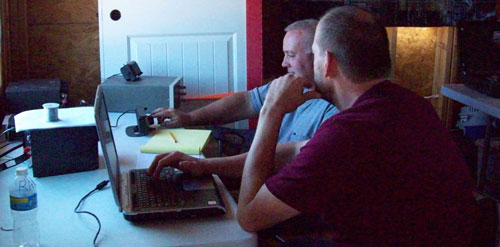
  Field Day 2010 Operations Filed in Contests on Jul.07, 2010 Conditions were generally not as good this year as last. We found that the settings for the antenna tuner that we made last year were still completely valid. The only problem we had was when we had the 160 meter switch turned on for 80 meters at one point, which may have led to some dismal results there. Ken (KF7FAM) joined John and I for his first Field Day this year. He started out by helping out with antenna construction, then by watching and logging while he learned the flow of the Field Day contact.   Ken logs as Randy operates     Later, he got more ambitious, and had his first HF contact, followed by several more throughout the weekend. I think he enjoyed each new section he contacted. As usual, we wern’t trying to maximize points, but were more interested in the technical setup, and the challenge of contacting as many sections as possible.   Ken making one of several HF contacts...

Field Day 2010 – Preparations Part 2

Image
  Field Day 2010 – Preparations Part 2 Filed in Contests on Jul.07, 2010 We first tried using the Receiver Noise Bridge to check the antenna operation, but could not get reasonable nulls an any band.  That was our first sign of trouble.  After hooking up the radio and the bias-T connections, we found the operation of the vertical pretty dismal on all bands.  We hauled out a battery to energize the band switching arrangement as needed while troubleshooting.   After fields day operations had started, we continued to debug the problem, while simultaneously doing some operating with the 135′ doublet (which worked great, as always!) We found some wiring errors, and fixed them.  Our expectations were high, but again, the antenna just did not perform well.   We decided to go back to basics and check with the simplest configuration.  We took the noise bridge out and measured the resonant frequency of the antenna with no matching network....