Posts

Kenwood SW-2000 Wattmeter Lamp Replacement
Image
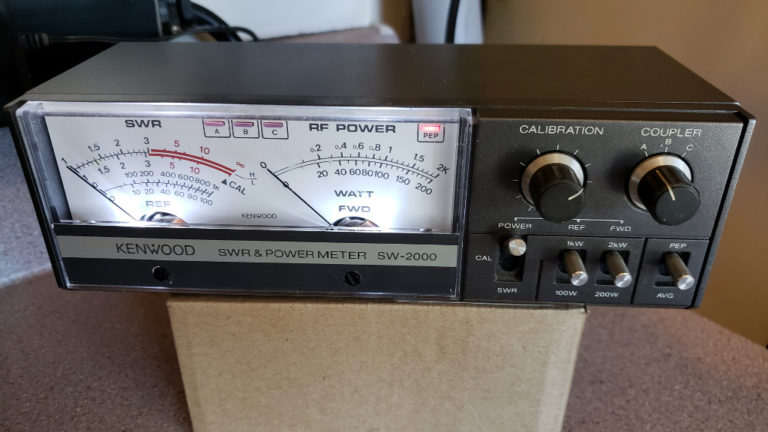
  Kenwood SW-2000 Wattmeter Lamp Replacement Filed in Wattmeters on Mar.28, 2021 I’ve been busy lately rewiring my hamshack. In the process, I have been doing some minor repairs to equipment that has deteriorated over the years. My Station Wattmeter, a Kenwood SW-2000 that I bought new in 1983, had long ago burned out its incandescent bulbs for the meters. So it is time to replace them with some new LED bulbs.   The job was not as easy as I had hoped. I removed the metal cover by removing four screws on the sides and one screw at the back top, near the center of the meter. Be careful, as the two front screws that attach the case to the meter place have captured nuts that may fall out. To get access to the light bulbs, the front cover plate for the meters must be removed. The screws are hidden under the product label at the bottom of the cover plate. The label is glued on, so it must be carefully be peeled off of the faceplate, hopefully keeping it i...
3018 CNC for PCB Milling?

Image
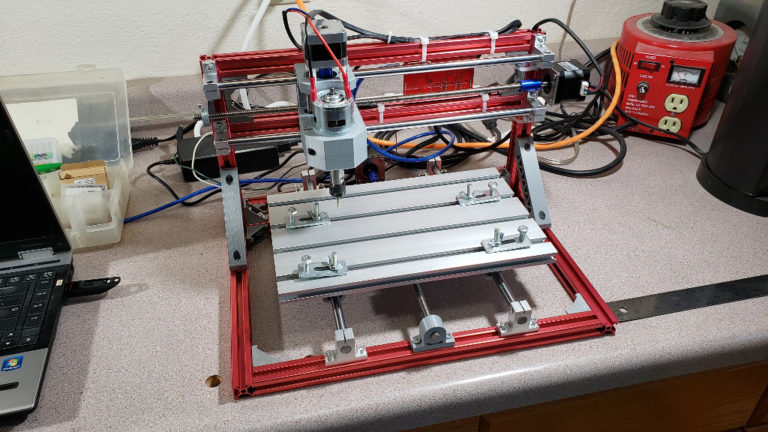
  3018 CNC for PCB Milling? Filed in CNC on Aug.05, 2020 I have started learning how to mill PCB boards using a benchtop CNC Router.   3018 CNC Assemble In the past, I have used a chemical etching method to create custom PCBs for some of my projects. While it was generally successful, there were some problems with the process. It was messy. Storing and mixing the chemicals used in the etching process inevitably led to some splashing of the chemicals on clothing, workbenches and other items of value. This was especially a problem when the Ferric Chloride solution was used, as it stained everything it touched. Using a muriatic acid/hydrogen peroxide solution was cleaner, but still problematic. Disposal of the chemicals was a problem. Even after heavy dilution, one worries about the environmental effects of the waste chemical disposal. After etching, the chemicals had an added quantity of copper. That complicates things. Until very recently, the c...

Thunderbird Hamfest 2020

Image
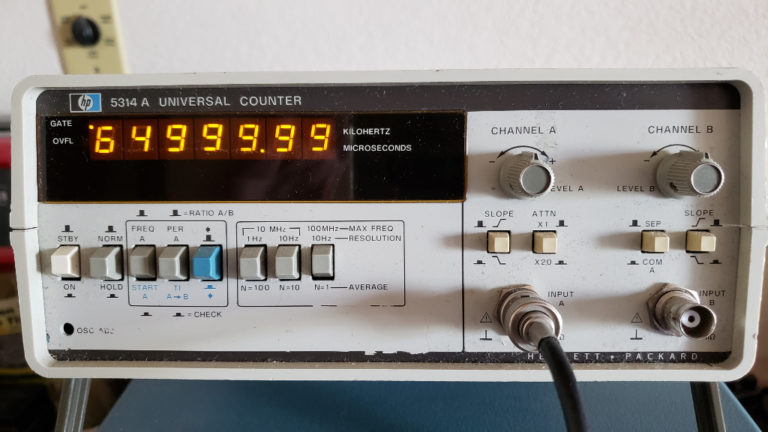
  Thunderbird Hamfest 2020 Filed in Operating on Jan.11, 2020 I always find good deals on test equipment on the West side of town. This year’s Thunderbird Hamfest continued that streak. I found an HP 3435A Digital Bench Voltmeter and an HP 5314A Frequency Counter at a reasonable cost (Total of $25 for the two). They are both functional.   HP 5314A Frequency Counter Also found was a 3456A Digital Voltmeter. This caught my eye because it has a 4-wire resistance configuration. I tested the Frequency Counter first. With approximately 65 Mhz input from my 8540B Signal generator, it read right on, with a little more precision than the 8640B can display. I cranked the frequency from 500 Khz to 130 Mhz. The 130 Mhz was the upper limit of the 100 Mhz rated counter. I already have a nice 100 Mhz counter, but wasn’t sure of the range of this new one when I bought it. I was hoping for a 300 Mhz or so, but that’s ok. The price was right. Period ap...

Nano_VNA Testing

Image
  Nano_VNA Testing Filed in VNA on Jan.02, 2020 This year, one of my Christmas presents was a Nano_VNA (Vector Network Analyzer). These are like an antenna analyzer on steroids. You can check the SWR of your antenna through a range of frequencies, and get detailed information about the antenna impedance, including whether it is inductive or capacitive at a given frequency. This information is useful in developing matching networks for your homebrew antennas. The Unit has the additional capability to inject a swept frequency range through a device and detect how much gets through the output of the device under test. So it should be great for sweeping filter networks (Low Pass, High Pass, Band Pass, Notch, etc…), as well as cavity filters used in repeaters. The Nano_VNA covers all frequencies between 50 khz and 900 Mhz. That is a pretty good range, and covers the VLF bands, all of the HF bands, 2 meters, the 220 Mhz band and the 70 cm band. Just to get ...

Debugging ANSRTrack – Part 3

Image
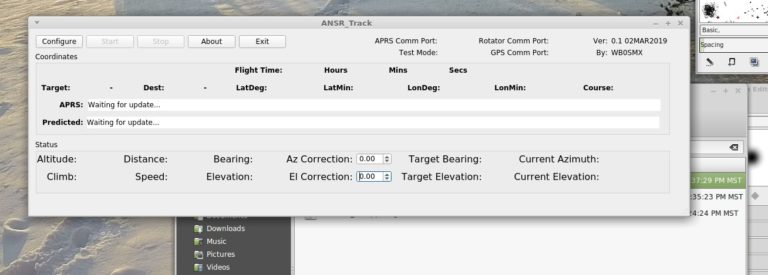
  Debugging ANSRTrack – Part 3 Filed in ANSR Tracker on Apr.04, 2019 Unexplained Rotator Movement There is one final problem noted during the inaugural flight with the new ANSRTrack Ground Station program. At a point about 30 – 45 minutes into the flight, the ground station received an APRS beacon from the balloon, on its normal 30 second interval. The azimuth rotor suddenly rotated about 45 degrees counterclockwise from its prior position. As I looked at the screen to determine what might have happened, we received another beacon, and the azimuth control returned to where it should have been pointing. This twice. Once at about 36 minutes into the flight, and once at about 42 minutes into the flight.   There are a couple of possible causes for this action. We may have received a bad packet from the APRS beacon on the balloon. We may have calculated the wrong bearing to the balloon for those two packets. There may be a communication proble...